Charge, Preceptor, and Float Premiums: What Role Pay Actually Adds
Beyond night, weekend, and holiday differentials, many hourly jobs — healthcare especially, but not only healthcare — have a second category of extra pay: role premiums. These are tied to what you actually did on a given shift, not to when the shift happened.
Charge pay
Charge pay compensates an employee for taking on charge-nurse or shift-lead responsibilities — overseeing the unit or team for that shift, on top of a regular patient or workload. It's typically a flat per-hour add-on, applied only to the hours actually spent in the charge role, not automatically to the whole shift if the role changed partway through.
Preceptor pay
Preceptor pay compensates an experienced employee for training or supervising a new hire, student, or orientee during a shift. Like charge pay, it usually applies to the specific hours spent precepting rather than the entire shift, and eligibility (how new an employee has to be, how long precepting lasts) is set by the employer.
Float or floating pay
Float pay compensates an employee for working outside their regular assigned unit or location — filling a staffing gap elsewhere for a shift. It recognizes the adjustment of working somewhere less familiar, and both the rate and the rules for when it applies are set by the employer.
What role premiums have in common
All three are usually:
- Tied to specific hours, not automatically the whole shift — if you charged for four hours of a twelve-hour shift, typically only those four hours carry the premium.
- Employer-specific. There's no universal rate or rule; what counts as a "charge shift" and how much it pays varies by employer, and sometimes by unit within the same employer.
- Stackable with differentials. A charge shift worked on a weekend night can carry a differential and a role premium at the same time — which is exactly what makes it easy to under- or overestimate a shift's value by hand.
A worked example: a premium shift
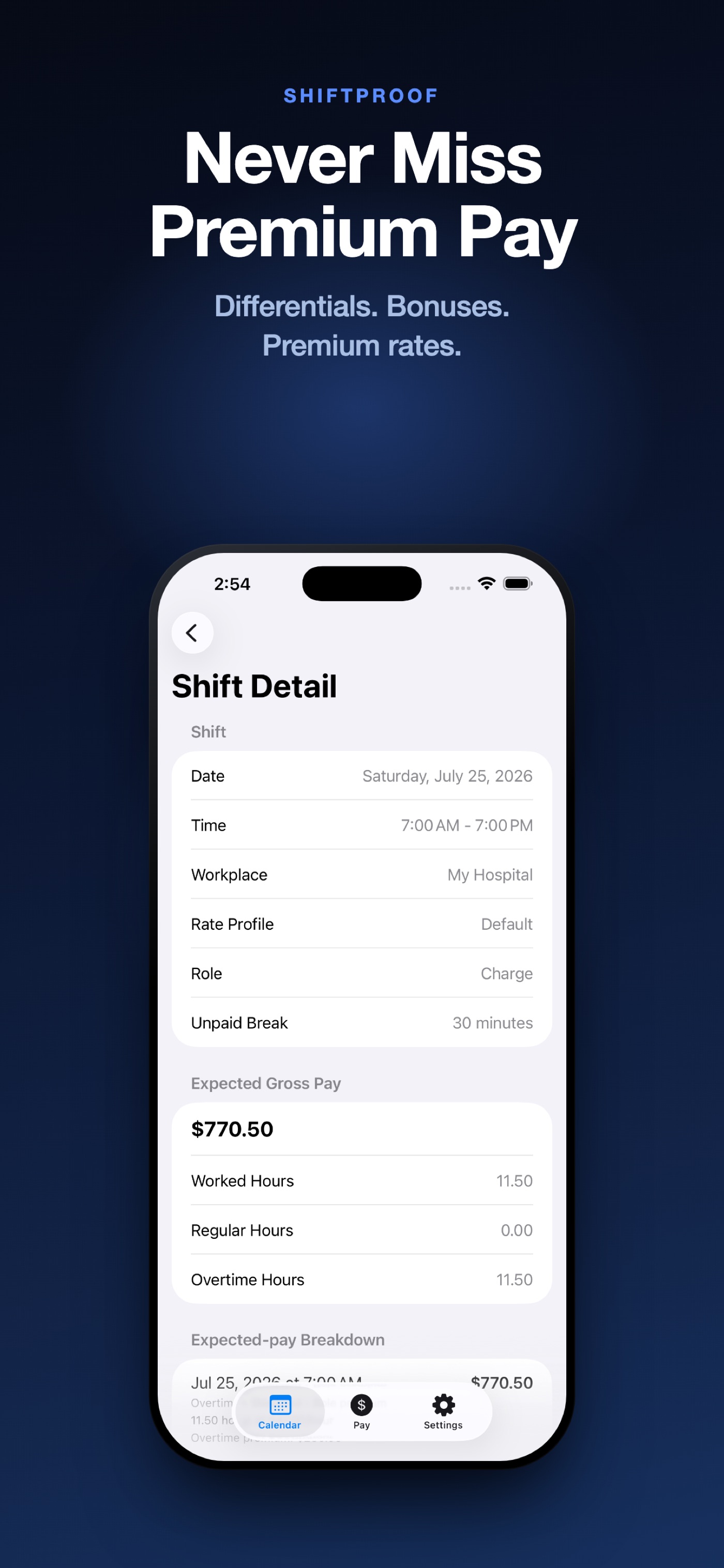
Here's a Saturday shift worked in the charge role, with a weekend differential and the charge premium both applying:
- Worked hours
- 11.50
- Overtime hours (entire shift fell past the weekly threshold)
- 11.50
- Expected gross pay (base rate + weekend differential + charge premium, at the overtime rate)
- $770.50
Compare that to a similar 11.5-hour shift with no differential or premium (worth $580.00 in the overtime example in our weekly overtime guide) — the gap between the two is entirely the weekend differential and charge premium, stacked on top of an already-overtime shift.
Checking role premiums on your paycheck
If a premium shift doesn't add up the way you expected, the usual causes are: the shift wasn't logged under the role that triggers the premium (charge vs. staff, for instance), the premium only applied to part of the shift and the rest was missed in your own math, or the rate you assumed for that premium isn't current. Confirming the exact hours you were in each role, and the current premium rates, with your employer or payroll department resolves most of these.
How WageTally handles role premiums
WageTally lets you set charge, preceptor, and float premiums once per workplace. When you add a shift, you assign it the role you actually worked — staff, charge, or whichever roles you use — and the premium is applied automatically for that shift, stacked correctly with any differential and folded into the expected gross pay.
Set your role premiums once. Every charge, preceptor, or float shift counted correctly.
Download WageTally FreeRelated guides
This guide is general information, not legal or payroll advice. Role premium names, rates, and eligibility vary by employer — verify specifics with your employer or payroll department.